
By Karen Hendricks
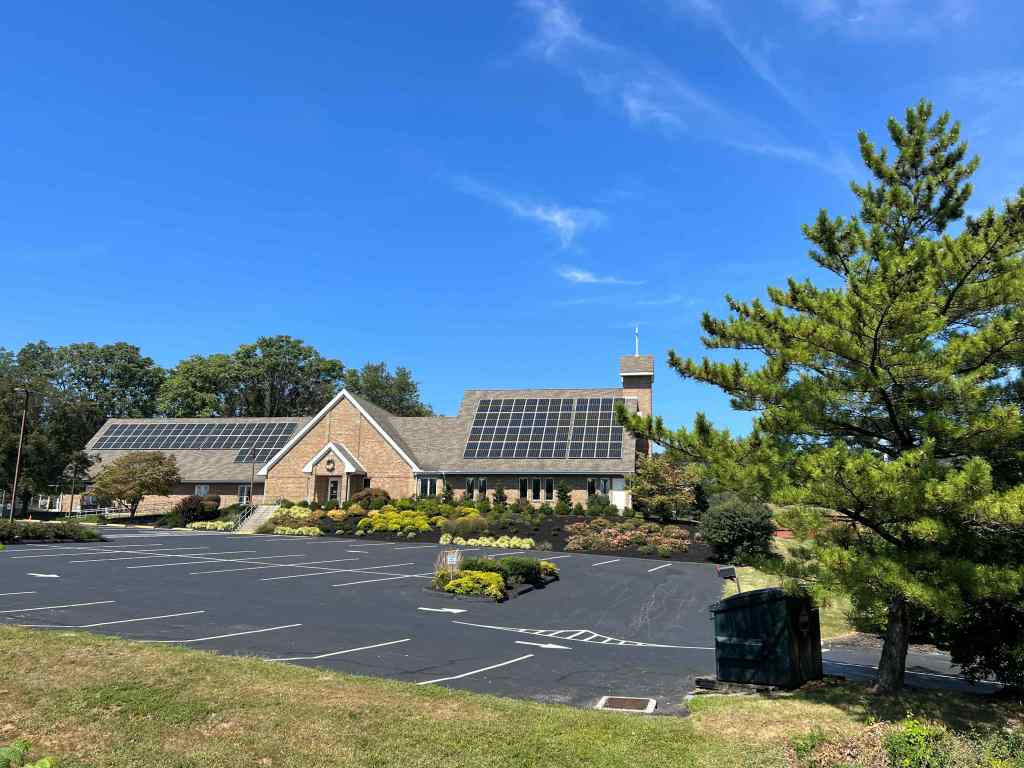
Between 10,000 and 12,000 vehicles pass Harrisburg’s Tree of Life Lutheran Church every day. The location, along the growing Linglestown Road corridor, helps the congregation make a highly-visible statement about their faith.
Beyond the neon message board, there’s another message, shining atop the church roof, in the shadow of the steeple: a roof full of solar panels.
“People are seeing the solar panels as an example of a green solution and a positive expression of what it means to be the church,” said the Rev. Richard Geib, Tree of Life’s pastor of 36 years.
The sun provides nearly all the power needed for the congregation’s three buildings.
It’s a scene playing out in other Pennsylvania communities, as houses of worship say solar lowers their carbon footprint as part of their responses to climate change and “creation care” called for in the Bible.
In Lancaster County, solar panels atop Akron Mennonite Church offset their electric bill — not only for their worship space, but for a large child care center within the church. And St. Andrew’s Episcopal Church in Lewisburg, Union County installed solar panels in August with a goal of becoming carbon neutral.
All three churches hope to inspire their communities—individuals, businesses and nonprofits—to switch to solar, as an alternative to fossil fuels.
The churches could be considered early adopters. Across Pennsylvania, solar power drives only half of one percent of the state’s electricity. The state ranks 26th in installed solar capacity through the second quarter of 2023, according to the Solar Energy Industries Association. It projects the state will rise to 20th over the next five years.
Continue reading, on WITF’s StateImpact Pennsylvania website, here. Story published on Oct. 18, 2023.
 Karen Hendricks